
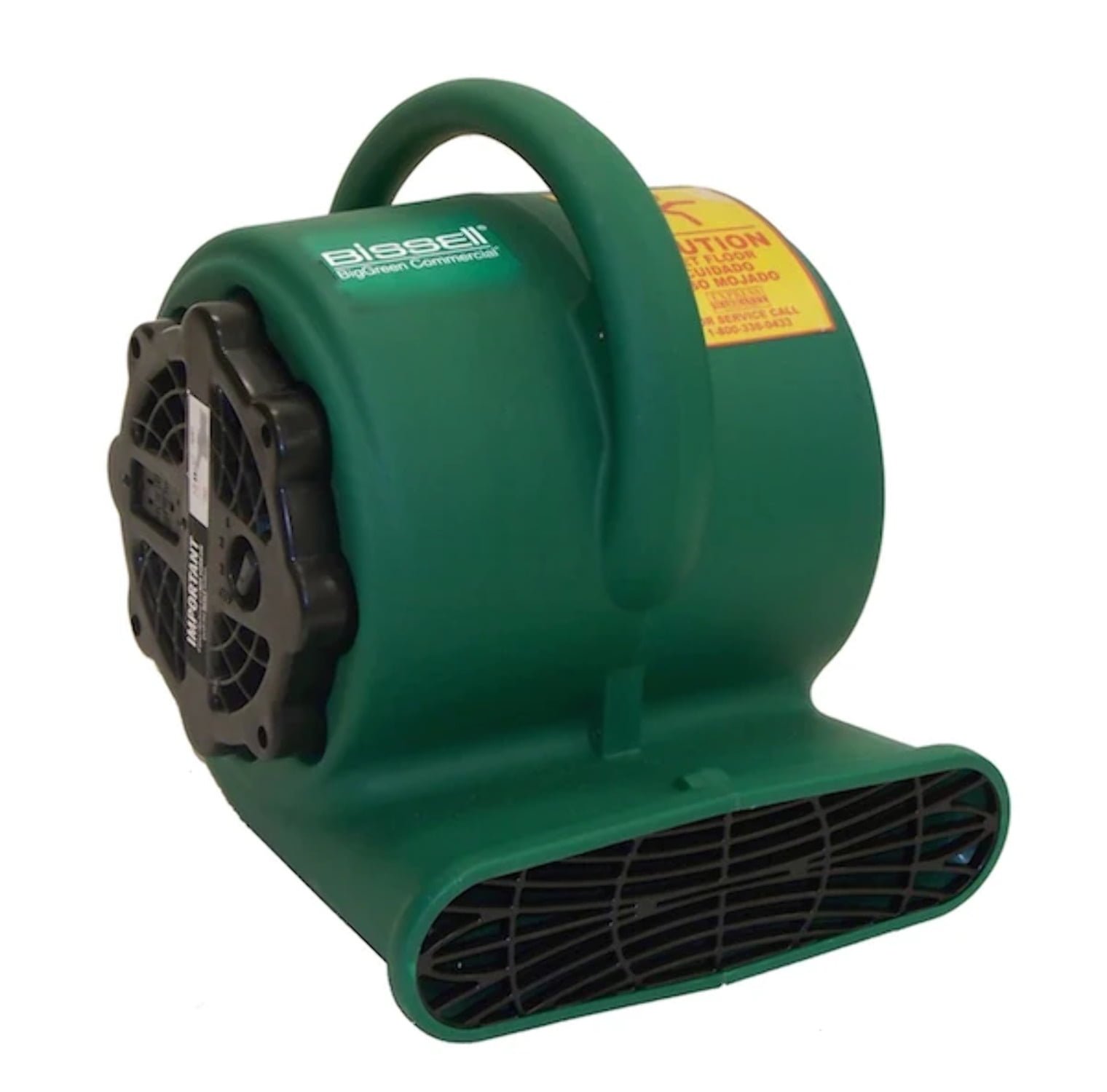
The BISSELL BigGreen Commercial BGAM3000 is a portable air mover designed to push high volumes of air across floors, carpets, furniture, and other surfaces during drying and restoration work. It is used in commercial cleaning, janitorial, facility maintenance, and water-damage response environments where moving air can help moisture evaporate. The manufacturer’s specification sheet lists three speeds, airflow up to 3,000 cubic feet per minute (CFM), a 9.5-inch blower fan, and four operating positions.
This guide explains the published specifications, typical applications, practical setup considerations, and the checks buyers should make before choosing the BGAM3000. Product documentation can change over time, so confirm the exact model marking and electrical information on the unit before ordering parts or comparing it with another version.
What is the BGAM3000 designed to do?
An air mover directs a focused stream of air over a surface. By increasing air movement, it can support evaporation from damp carpets, hard floors, upholstery, and building materials after routine cleaning or water intrusion. It is not a dehumidifier: an air mover circulates air, while a dehumidifier removes moisture from the air. In a restoration project, the two types of equipment may be used together as part of a broader drying plan.
The BGAM3000 is a portable blower-style unit rather than a conventional room fan. Its low profile and adjustable outlet allow airflow to be aimed in several directions. The unit is therefore suited to targeted drying rather than simply cooling a room.
Published BISSELL BGAM3000 specifications
The manufacturer’s BGAM3000 specification sheet lists a 1/2 horsepower motor, a three-speed switch, and airflow settings of 2,400, 2,700, and 3,000 CFM. It identifies a 9.5-inch diameter blower fan and a heavy-duty polyethylene housing.
| Specification | Published detail |
|---|---|
| Model | BGAM3000 |
| Motor | 1/2 HP; specification sheet lists 6.5 amp draw |
| Airflow | 2,400 / 2,700 / 3,000 CFM |
| Blower fan | 9.5-inch diameter |
| Positions | Four positions with kickstand |
| Housing | Heavy-duty polyethylene |
| Power cord | 25-foot safety cord, 16/3 gauge |
| Stacking | Manufacturer says units can be stacked up to three high |
| Weight | About 30 lb according to the sheet |
Because the sheet is an older manufacturer document, treat these as published reference specifications rather than a substitute for the actual nameplate. Confirm electrical rating, plug type, cord condition, and any revision-specific details on the machine you intend to buy.
Understanding the three airflow settings
The three-speed switch allows an operator to choose between 2,400, 2,700, and 3,000 CFM as listed in the product sheet. Maximum airflow is not automatically the best setting for every job. A lower setting may be suitable when directing air close to delicate materials or when noise and power use are concerns. A higher setting may be useful when the surface and site conditions can tolerate stronger airflow.
Airflow performance depends on the setup. Obstructions, clogged intake areas, damaged grilles, and poor placement can reduce effective movement. Keep the intake clear and avoid positioning the outlet so that it simply pushes moist air into an enclosed pocket with no ventilation or moisture-removal plan.
Four operating positions and common uses
The four-position design is one of the BGAM3000’s practical features. The kickstand and housing allow the outlet to be aimed at different angles. This helps users direct air across hard floors, carpets, furniture, curtains, or ceiling areas when the work site and safety conditions permit.
Carpet and hard-floor drying
After extraction cleaning or a small spill, an operator may position the unit to move air across the damp surface. Air movement can support evaporation, but it does not remove standing water or replace extraction. For heavily saturated materials, first remove as much liquid as possible and assess whether the material can be dried safely.
Furniture and upholstery
Air movers can assist with drying upholstery or furniture after cleaning, provided the airflow direction and intensity are suitable for the material. Follow the upholstery manufacturer’s care instructions and avoid directing air in a way that disturbs fragile finishes, loose fabric, or small objects.
Restoration and facility maintenance
In larger restoration jobs, air movers are usually part of a system that may include water extraction, dehumidification, moisture measurement, and controlled ventilation. One blower alone does not establish that a structure is dry. Moisture meters and documented inspection are important when wall cavities, subfloors, or building assemblies have been affected.
Stackable design and portability
The specification sheet says the units can be stacked up to three high to save storage space. This can be helpful for restoration contractors and cleaning teams that transport several machines. Stack only according to the product instructions, on a stable surface, and never in a way that blocks ventilation or creates a tipping hazard. The integrated handle and approximately 30-pound stated weight make the unit transportable, though operators should use safe lifting practices.
Electrical and job-site safety
Inspect the power cord, plug, housing, grille, and switch before each use. Do not operate equipment with damaged insulation, exposed conductors, a cracked case, or a loose plug. Keep connections away from wet areas and follow the manufacturer’s electrical instructions. Use a properly rated supply circuit and avoid daisy-chaining extension cords or power strips. A safety device such as a GFCI may be required or recommended in damp work environments; follow local electrical rules and site procedures.
Also consider airflow and indoor air quality. When drying after a water event, determine whether the water was clean or contaminated and whether professional remediation is required. The EPA’s guidance on mold and moisture explains why moisture control and rapid response matter, but it does not mean that blowing air is sufficient remediation. Do not use a fan to spread dust, mold contamination, or hazardous particles through an occupied building.
What to check before buying
- Confirm the model is specifically BGAM3000 and read its electrical nameplate.
- Inspect the intake and outlet grilles for cracks, missing sections, or accumulated debris.
- Test all three speed settings and listen for abnormal vibration or bearing noise.
- Check the power cord, plug, switch, handle, and kickstand.
- Ask whether the unit is new, refurbished, used, or sold as-is.
- Confirm the current warranty and availability of replacement parts with the seller or manufacturer.
- Check whether the 25-foot cord and plug type meet the needs of your work site.
For cleaning and turnover operations, see our Home Improvement articles, Real Estate guides, and our article on short-term rental cleaning services. The CDC cleaning and disinfection guidance is also useful for distinguishing routine surface cleaning from situations where disinfecting is appropriate.
Frequently asked questions
How much airflow does the BGAM3000 produce?
The manufacturer’s specification sheet lists three speeds: 2,400, 2,700, and 3,000 CFM.
Can it be used to dry carpets?
Yes, it is designed to direct air across carpets and other surfaces. Remove excess water first and use appropriate moisture measurement and dehumidification for larger drying jobs.
Is it a dehumidifier?
No. It moves air. A dehumidifier removes moisture from the air, and the two can be used together in a suitable drying plan.
Can BGAM3000 units be stacked?
The manufacturer sheet says they can be stacked up to three high. Follow the product instructions and use a stable storage arrangement.
A practical drying workflow
For a small cleaning or water-removal job, begin by identifying the source of moisture and stopping it where possible. Extract standing water with suitable equipment before setting up an air mover. Remove items that could be damaged, protect electrical connections, and determine whether the water is clean or contaminated. Position the blower so that air moves across the damp surface rather than directly into an obstructed corner. Use the lowest suitable speed at first, then adjust as the work area and material allow.
In a larger job, place air movers according to a drying plan and monitor the moisture in the affected materials. A surface that feels dry may still contain moisture below the surface or inside a wall or subfloor. Dehumidification, ventilation, and professional assessment may be needed. Record the starting condition and repeat measurements at consistent locations so that drying progress can be judged rather than guessed.
Care and maintenance between jobs
Unplug the unit before inspection or cleaning. Check the air intake, outlet screen, and housing for dust, lint, carpet fibres, and debris. Clean only as permitted by the manufacturer and do not open electrical components unless you are qualified to do so. Inspect the cord along its full length, including the plug and strain relief. A cracked housing, damaged grille, unstable kickstand, or unusual motor noise should be addressed before the next job.
For storage, allow the unit to cool and dry, keep the cord loosely coiled, and avoid placing heavy items on top of the housing. When transporting multiple units, secure them so they cannot shift or fall. The manufacturer’s stated stack limit is a storage feature, not permission to create an unstable stack on a vehicle or uneven surface. A short maintenance log can record dates, faults, repairs, and replacement parts.
Conclusion
The BGAM3000 is a commercial air mover with three airflow speeds up to 3,000 CFM, a 1/2 HP motor, four adjustable positions, and a stackable polyethylene housing. Its value depends on the condition of the unit, the exact electrical specification, and whether the blower suits the drying work you need to perform. Verify the nameplate and accessories before purchase, and treat air movement as one component of a complete moisture-control process.
